


Choosing a Market

Selling books at markets sounds simple: figure out where your readers are, set up a table, and sell them books.
If only.
The basic idea is sound. My friend, a food critic, wrote a book about the evolution of Southern cooking. Farmers’ markets and foodie conferences were obvious possibilities.
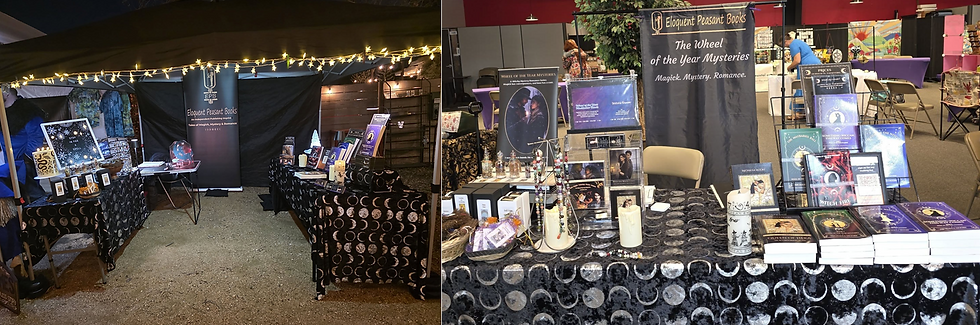
I write witchy romantic suspense, so I go to witch markets, pagan events with a vendor area, craft fairs, and book festivals.
Finding a market that caters to your target audience is only the beginning. When I started doing markets, I didn't consider one very important thing: inside or outside?

Farmers’ markets and pagan festivals are probably outside, but not always.
Conferences and book fairs are probably inside, but not always.
Witch markets and craft fairs can be either.
Some events are both. The main event is inside, but outside tables may be available at a reduced price. (Ask yourself why the price is reduced.)
So, what do you need to consider when deciding if you’ll be inside or out?
The pros and cons of each type of event
Geography and weather
Parking, something that’s easy to overlook until you’re hauling around a small bookstore

I’ve done both indoor and outdoor events. I’ve absolutely loved both, and I’ve hated both.
Indoor | Outdoor |
Pros CONTROLLED ENVIRONMENT. Weather isn’t usually a factor.
LESS TO HAUL. No tent or weights. Tables and chairs may be provided.
POWER/LIGHTING/AMENITIES. Better lighting, electricity, and nearby bathrooms, not porta-potties. Keeping your phone/card reader alive all day isn’t a problem. | Pros WALK-IN TRAFFIC is more likely. YOU'RE OUTSIDE. You missed Burning Man this year, but you're outside, girlfriend. There’s more energy, more spectacle, and more reasons for customers to wander around and find YOU. YOUR CANOPY DEFINES YOUR SPACE. Height, walls, banners, and décor create an environment. |
Cons FEWER WALK-INS. An indoor event is usually a destination. IT'S HARDER TO CREATE A WORLD Your display must work harder to say, “This is me” when you’re allowed one table in a row of tables. | Cons WEATHER IS YOUR BUSINESS PARTNER. . . and your partner is unreliable. Rain. Wind. Heat. Cold. Mud. MORE EQUIPMENT, MORE SETUP. You’re moving a small bookstore. You have to bring the store with you, and you also have to build it. |

Geography and Weather
If you live in the Upper Peninsula, where winter highs are in the 20° range, your markets are likely inside.
I live in Austin, Texas. We have outdoor markets year-round. A January day can be a sunny 75°, or rainy and windy with a high in the 30s.
Summer has its own challenges. Several vendors, including me, stopped doing outdoor markets in June, July, and August when nightly lows were in the 80s, and daytime temperatures hit the high 90s and low 100s.
Remember, your customers are not mail carriers. They did not sign up for Neither snow nor rain nor heat nor gloom of night stays these couriers from the swift completion of their appointed rounds.

Although weather mostly affects outdoor events, several indoor “bookish” events in the Northeast were recently canceled or rescheduled because of it.
Remember: you need to know what happens to your merchandise and tent if the weather turns bad — including gusts of wind that carry your tent away and bang someone on the head. (I know this from experience because someone’s tent nearly took me out.) You can buy insurance for individual events, but depending on the policy cost and your expected sales, you may insure yourself right out of profit.
So, what do you need to know about the weather?
Who decides when conditions are unsafe?
What is the weather cancellation/refund policy? Is the event explicitly rain or shine?
Is there a weather backup plan? Can an outdoor event move inside, postpone its opening, close early, or move to another date?
What happens to the fee if you decide conditions are unsafe but the organizer proceeds?
What happens to your inventory during bad weather?

Weather damages a market in different ways:
The event is canceled — obvious.
Customers don't come — the event technically happens, but sales collapse.
Vendors don't come — the event happens (technically), but it looks half-empty.
Weather fatigue — Austin's year-round market calendar encourages organizers to underestimate weather fatigue. A single bad day is one thing. A month of repeatedly loading up while checking radar, protecting inventory from rain, heat, wind, drying canopies, dealing with mud, and packing up in an emergency takes its toll. Eventually, vendors don't need an official cancellation policy. They simply stop signing up.

Customer Parking
Where will customers park, and how far will they walk? Is the route covered or shaded? In Austin, five blocks uphill in 102° heat can kill attendance as fast as a blizzard.
Do they have to pay for parking? That's not uncommon in urban areas. If your customers have to pay $30 to park, they may stay home. At the very least, that's $30 they've already spent before reaching your table. There’s always a budget, even if it's lurking in their subconscious.
Vendor Parking
Where will you park while loading a small bookstore into and out of the venue?

The Weight Adds Up
Canopy and weights: 200 pounds. Canopy: 38–40 pounds. Required weights at many markets: 160 pounds.
Table and chairs: about 40 pounds. A six-foot table weighs about 24 pounds; chairs run 5–13 pounds each.
Books: 75 pounds. Ten of my books weigh about 15 pounds. I bring five boxes.
Wagon: 25 pounds — empty.
Swag: bookmarks, sales materials, cashbox, bags, etc. Honestly, I’ve never weighed it because I REALLY don't want to know.
Before I load swag into the wagon, I'm already hauling almost 350 pounds.

Can you drive to your booth to load and unload?
A distant vendor lot may be perfectly acceptable if you can drive to your booth, unload, and then move your car.
It’s a different proposition if you're expected to haul everything from P3.
Even an indoor event with nearby parking can have issues. At one event, getting inside meant pulling my wagon up a ramp as steep as the final ascent to Mount Everest. And like Everest, the descent was even harder. The wagon gathered serious momentum, careened out of control, and nearly crashed into other vendors and parked cars, taking me with it.
Conclusion
Finding your target audience is only the beginning. A market can look perfect on paper and still be the wrong event for you.
I've had great indoor markets and great outdoor markets. I've had miserable versions of both.
Now, before I send in a vendor fee, I no longer ask only, “Are my readers going to be there?”
I also ask, “Where, exactly, is there?”
And above all, have fun!


Comments