


Why My Witch Solves Mysteries with Tarot — Not Magic Spells
- Michalea Moore
- Mar 15
- 4 min read

Fifteen years ago, I had an idea for a mystery novel. The sleuth would be a witch.
The problem? I had no idea how a witch would actually solve the crime.
Spells? Too easy.
Crystal balls? Too predictable (no pun intended).
Talking cats? Absolutely not.
What I did know was that any fictional character worth their salt has a talent, a gift, a superpower. It’s their edge, their curse, their ticket to trouble. A real gift stirs conflict, drives the plot, and slices straight to the story’s heart. It’s not just a power. It’s a test. It’s a superpower. What I needed was a power that felt real.
That search eventually led me to the Tarot — and turned the cards into one of the most important characters in The Wheel of the Year Mysteries.
Tarot isn’t about predicting the future.
It’s about revealing the story we’re already living — the choices, fears, and turning points we may not see clearly yet.
Building a Modern Witch
By the time I began writing the first book, I had the basic setup: A modern witch accused of murder = Instant stakes.
But how would she prove her innocence?
I knew I didn’t want a cartoon witch.
No nose-wiggling. (Yes, I practiced the nose wiggle as a kid. No, it didn’t work.)
No talking cats.
No convenient fireballs.
I wanted something else entirely:
A damaged, tech-savvy witch who brews potions between Zoom calls, writes spells on her Book of Shadows blog, and has zero patience for toxic people.
Her magick needed weight and consequences.
The Wrong Turn: The I Ching
“Write what you know,” right?
In college, I loved the I Ching, the ancient Chinese system of divination. For a while, I thought it would be perfect for my witch. She could cast coins and interpret the hexagrams to uncover clues.
But when I tried it again, the connection just wasn’t there anymore.
The magic had faded.
Time to pivot.
The Spark: Tarot and Storytelling
As a Rhetoric/English major, the Hero’s Journey had been drilled into my brain: the classic arc of transformation — ordinary world, trials, revelation, return. Great structure.
During a writing seminar, Chris Vogler (the story architect behind The Lion King) mentioned something that stopped me cold: The Hero’s Journey mirrors the journey through the Tarot’s Major Arcana. SAY WHAT?
That idea sent me down a rabbit hole.
I enrolled in an eight-week Tarot for Writers course taught by Kris Waldherr, creator of The Goddess Tarot. And suddenly everything clicked. It's now available as a book.
My witch wouldn’t toss coins and wait for answers.
She would command the Tarot.

Tarot as a Storytelling Engine
Once I started digging, I realized I wasn’t alone in seeing Tarot as an artistic tool. Many artists use it for creative inspiration. (How This Artist Is Using Tarot Cards To Manifest A Hopeful Future or Story Starting with Tarot.)
For my series, Tarot became more than symbolism.
It became a character in the story.
Now that I’m writing Book Four, My Brother's Keeper, Tarot readings are as central to the series as my two protagonists:
Maren Lilienthal — the witch
Cyrus Harper — her billionaire, tech-industry partner.
The Problem With Tarot in Fiction
Before I started writing, and during the process, I read several novels that used Tarot as a central part of the plot, such as Arcana Academy, The Fortune Seller, and The Cloisters. I also read a lot of witchy novels where Tarot made a brief or occasional appearance. I also noticed Tarot popping up unexpectedly in books like the Poldark books, on which the popular television series was based. (Side note: I read all twelve books.)
But I kept running into the same problem: Tarot scenes often pull readers out of the story.
Here’s my confession: even though I read Tarot for myself, when a novel casually mentions a card — say the Seven of Swords or the Five of Cups — my brain sometimes blanks.
Suddenly I’m wondering: Wait… what does that card look like again?
Then, I’m either flipping through a Tarot deck or Googling images instead of reading the story.
Momentum: gone.
My Three Rules for Tarot in Fiction
So when I started writing the series, I made three rules — and refused to compromise on any of them.
No fake Tarot scenes. The readings had to feel authentic and meaningful. No mystical window dressing.
Make it visual — but fast. Readers should see the cards instantly, without slowing the pacing.
Respect Tarot readers. Experienced readers should recognize when Maren interprets the cards brilliantly … and when she completely misreads them.
The Solution: Show the Cards
The answer was simple.
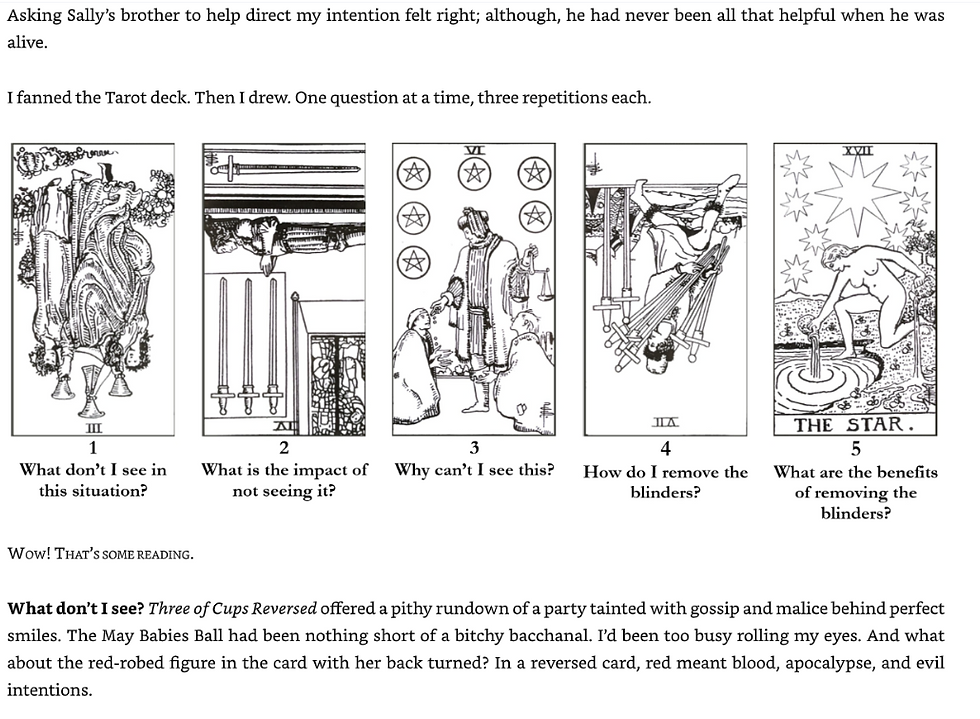
Instead of just describing the readings, I show the actual spread Maren sees.
Each reading includes real Rider-Waite card images, so readers experience the moment visually, the same way Maren does.
It keeps the pace moving — and keeps the magic grounded.
Why Rider-Waite?
I didn’t choose the deck casually.
During the Tarot for Writers class, about twenty students compared their favorite decks. Some were devoted Tarot readers; others were beginners.
Opinions varied wildly. But one thing was clear: Everyone knew the Rider-Waite deck.
That made it the perfect choice for the books. Many readers may know nothing about Tarot, so I wanted a deck that felt familiar and accessible.
There was also a practical advantage.
The Rider-Waite artwork is out of copyright and relatively easy to license, which meant I could legally include the images in the books.
In the end, it felt less like I chose the deck … and more like the deck chose me.
See for Yourself
Here’s a page from The May Babies Ball, where Maren tries to uncover the truth behind the murder of her best friend.
Coming Soon: How I Create the Tarot Readings for the Wheel of the Year Mysteries Because yes — there’s a method behind the magic.


Comments